

 insights

Introduction: The Crucial Early Steps of Medical Device Development
If you want to bring an innovative medical device to market, you will experience hurdles such as strict regulation, technical requirements, and the critical need to establish market fit. For medical device startups, the initial choices made during the concept phase set the course toward the long-term viability of the product. Many innovators possess an excellent clinical concept and simply need access to the specialized engineering, intellectual property, regulatory, quality, and manufacturing experience required to transform an idea into a commercial reality.
Without a multidisciplinary review at the start, teams risk spending capital on designs that may face unexpected regulatory requirements or manufacturing challenges later. This case study explores how Dr. Joseph Burkett, Founder and CEO of SealJect Medical, partnered with Kapstone Medical to execute a comprehensive Phase 0 Feasibility study to de-risk his invention in biopsy technology.
Key Takeaways:
- Comprehensive Risk Mitigation: Dr. Burkett’s Phase 0 Feasibility study combined market research, regulatory assessment, IP landscaping, concept design, and manufacturability to answer critical questions before committing time and capital.
- Single-Source Advantage: Kapstone Medical’s integration of multidisciplinary expertise gives startups critical access to engineering concepts, regulatory assessments, manufacturing, and commercialization experts who collaborate for the best result.
- Actionable Strategic Roadmaps: The primary output of this feasibility study was a clear development roadmap with defined concepts, more refined budget and timeline estimates, and a go to market strategy that was collaboratively built.
- Regulatory Alignment: Evaluating clinical requirements and regulatory landscapes early prevents costly design and test iterations later in the development process.
The Challenge: Evaluating a Concept Before Deploying Pre-Funding
SealJect Medical entered the medical device landscape with a clear mission: to advance patient care by mitigating the inherent complication risks associated with standard core needle biopsy procedures. The company was founded by Dr. Joseph Burkett in the Spring of 2022, inspired by conversations with nephrologists at Johns Hopkins University Hospital who emphasized the critical need for safer biopsy techniques.
Rather than a simple mechanical instrument, Dr. Burkett was envisioning a sophisticated platform medical device, a semi-automated biopsy gun. The engineering concept was multi-faceted, exploring two distinct pathways to achieve rapid hemostasis: the sequence-specific delivery of photopolymerized hydrogels capable of sealing against high-pressure bleeding, and integrated localized cautery to seal the biopsy wound with minimal surrounding tissue damage.
Since this innovation included mechanical hardware, advanced material chemistry (hydrogels), and energetic tissue ablation (cautery), the development challenge was multifaceted. Like many early-stage medical device companies with complex platform technologies, SealJect possessed several patent pending applications across hardware, sealants, and methods. To deploy their capital efficiently, they needed an objective, multidisciplinary evaluation to validate their technical assumptions, map their intellectual property, and chart a predictable path through evolving regulatory frameworks before diving into a full development project.
The Solution: Kapstone Medical’s Multidisciplinary Phase 0 Feasibility Study
To address SealJect Medical's objectives, Kapstone assembled a team of experts from engineering, intellectual property, regulatory, and manufacturing disciplines. This team executed a structured Phase 0 Feasibility study designed to analyze every critical angle of the product concept before advancing to formal design controls.
SealJect Medical’s Phase 0 Feasibility framework integrated three essential services:
1. Intellectual Property
The engineering team conducted a detailed investigation into the existing patent landscape surrounding biopsy safety mechanisms. This effort ensured that SealJect's design concepts possessed a viable path toward patent protection while avoiding potential infringement risks with established commercial products.
2. Market Research
Kapstone analyzed current market conditions, clinical workflows, and user needs. This foundational research validated the market demand for the device and ensured that the engineering requirements aligned directly with the practical needs of interventional clinicians.
3. Strategic Regulatory & Clinical Assessment
A core component of Kapstone's single-source solution is its deep regulatory affairs capability. The team evaluated the device's technology against FDA classification criteria to identify the most efficient regulatory pathway, such as a 510(k) notification or De Novo pathway, while detailing the specific clinical data or preclinical testing required for eventual submission.
By evaluating technical feasibility alongside regulatory requirements, startups avoid the fragmented communication and conflicting timelines that typically occur when hiring multiple separate consultants.
4. Define the concept and build the critical mechanism
The design summary from the feasibility stage addressed the following areas of product engineering and manufacturability.
-
What might an actual Proof of Concept look like?
-
Where can the device and its components be sourced and manufactured?
-
What would an initial cost to manufacture look like?
-
What compatible devices or components already exist on the market?
-
Are there any technical risks associated with designing and sourcing the components?
The Results: A Clear, Actionable Path Forward
The result of this engagement was customized technical reports, thorough explanations, and actionable insights for all aspects of initial product development. SealJect Medical received a tailored development blueprint outlining what it would take to design, manufacture, and clear their biopsy device.
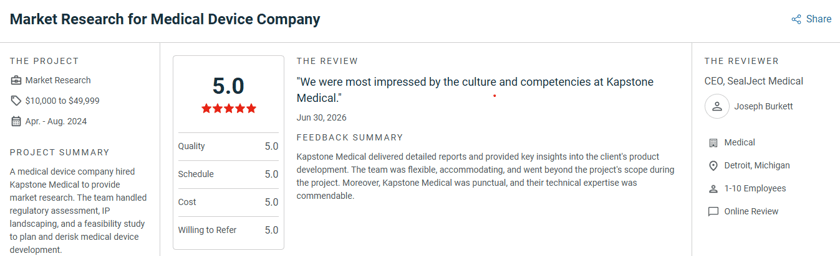
In his verified feedback on Clutch, Dr. Joseph Burkett detailed his 5-star experience with Kapstone Medical measured across all evaluation categories, including quality, schedule, cost, and willingness to refer. Dr. Burkett noted:
"We were most impressed by the culture and competencies at Kapstone Medical. They are rock solid on the technical aspects of product development, but they provided so much extra value beyond the basic engineering deliverables and stepped up to the plate when we needed extra services".
Furthermore, the review highlighted that Kapstone's cost structures were uniquely well-suited for early-stage organizations, stating that the services,
"...have been much more reasonable than other firms, which was especially helpful to our small startup".
How Kapstone Helps Get Your Medical Device to Market
While a Phase 0 Feasibility study provides an ideal entry point for startups like SealJect Medical, Kapstone's vertically integrated model is built to support medical device innovators across their entire operational lifecycle. By offering a single-source solution, Kapstone eliminates the friction of handing off a project between separate design firms, contract manufacturers, and regulatory consultants.
- Startups: Focus on proving concepts and developing finished ready-to-market devices, establishing solid IP footing, defining regulatory pathways, and securing initial seed funding through robust feasibility data.
- Mid-Stage Growth Companies: Benefit from formal design controls, human factors engineering, prototyping, quality management system (QMS) implementation, and verification/validation testing.
- Established OEMs: Utilize Kapstone Medical and Kapstone Manufacturing as a single source for scalable R&D and contract manufacturing, supply chain optimization, and ongoing regulatory compliance support for commercialized device portfolios.
Kapstone Medical’s strategy is to bring together engineering, intellectual property, regulatory affairs, and manufacturing experts into a single integrated team during feasibility stage to give our clients a clear path to an effective, compliant, and commercially viable medical device.
We are grateful to Dr. Burkett and the SealJect Medical team for sharing their experience and look forward to continuing to advance patient care in biopsies together.
Frequently Asked Questions: Understanding Phase 0 Feasibility
What is a Phase 0 Feasibility Study?
A Phase 0 Feasibility study is a preliminary evaluation performed at the very beginning of the medical device development process. It is designed to evaluate a product concept's technical, regulatory, intellectual property, and economic viability before a company invests more significant time and capital in a full NPD project.
Why do medical device startups need an IP landscape assessment early?
An intellectual property (IP) landscape assessment evaluates existing patents and pending applications within a specific technology space. For startups, performing this analysis early ensures they have a clear "freedom to operate" and avoids the severe risk of designing a product that unintentionally infringes upon existing patents.
Why do medical device startups need a Regulatory Assessment early?
Investigating your device's regulatory landscape early will pay dividends in the long run, saving significant time and capital later in development. Many promising new projects encounter costly hurdles or rework, not because the underlying technology was flawed, but because the team didn't ask the right, thought-provoking questions early enough, or didn't know what questions to ask in order to arrive at the answers needed to shape a sound development plan. Regulatory strategy, engineering design, and clinical evidence are inherently interconnected, yet product development teams often treat them as separate workstreams tackled in sequence rather than as a single, integrated plan from the outset. A regulatory assessment establishes your device's classification, its corresponding pathway to market (such as an FDA 510(k), De Novo, or PMA), and the testing required to support submission. Defining these requirements upfront, before key engineering decisions are finalized, helps ensure the development path is efficient, cost-effective, and aligned with a realistic, predictable timeline to market.
What are the benefits of a single-source medical device development partner?
A single-source development partner provides all necessary services, including design engineering, regulatory affairs, quality assurance, and contract manufacturing, as one point of contact. This vertical integration eliminates communication gaps, reduces project timelines, minimizes compliance risks, and can lower long-term development costs compared to managing multiple separate vendors.
Additional Resources
- Kapstone Medical Phase 0 Services: Learn more about our comprehensive early-stage offerings on the Kapstone Medical Phase 0 Feasibility Page.
- The Feasibility Methodology: Explore how multidisciplinary studies protect your capital by reading From Sketch to Roadmap: How a Multidisciplinary Feasibility Study Moves Medical Device Development Forward.
- New Product Development Roadmap: Learn about our full development process for medical devices in our New Product Development Roadmap.


