


 insights

Introduction
For many clinical professionals, the inspiration for a new medical device comes directly from the front lines of patient care. An emergency physician encounters a recurring clinical bottleneck, sketches out a rough concept, and may even think about it for years.
The biggest challenge may not be the idea itself. It is often in finding a trustworthy partner to guide you in how that concept could become technically and commercially viable.
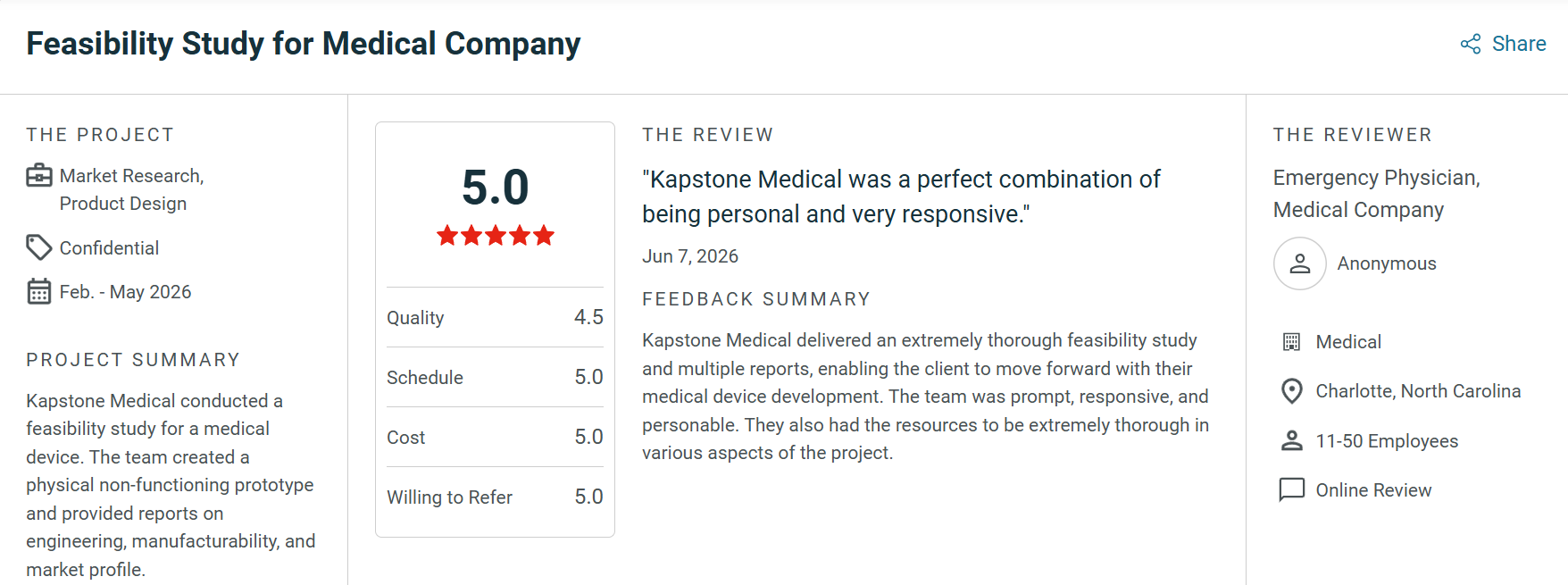
A recent verified client review on Clutch highlights this exact journey, detailing how an Emergency Physician partnered with our team to execute a comprehensive Phase 0 Feasibility Study from February to May 2026. This collaboration demonstrates how our multidisciplinary team can turn a preliminary sketch into valuable progress and an investable development roadmap.
Key Takeaways:
- The Power of an Ally: Bringing a long-held medical device concept to life requires early validation from a dedicated team that shares your enthusiasm and understands your clinical vision.
- Multidisciplinary Evaluation: A complete Phase 0 study looks beyond basic engineering to also evaluate regulatory pathways, the competitive landscape, manufacturability, and the intellectual property (IP) framework concurrently.
- Iterative Design Discovery: Collaborating with an experienced engineer can lead to innovative design options and features that inventors may not have previously considered.
- Early Regulatory Clarity: Working out the regulatory strategy upfront determines what testing will be required and prevents unexpected, costly design overhauls late in the commercialization process.
Step I: Finding an Ally to Share the Vision
Getting from a clinical concept to an engineered medical device can feel like a major undertaking for solo inventors. Our client notes how critical the initial kickoff alignment was to gaining momentum:
"I approached them with a rough idea for a medical device I'd like to use in my own medical practice and that I think would overall benefit the medical community. It was great to see John get excited about the idea during our opening meeting and finally gaining an ally to move forward with a project I've thought about for years."
This initial alignment forms the foundation of an effective Phase 0 strategy. The entire team must fully grasp the clinical intent and the overarching vision right from the start to ensure the resulting study focuses on the most critical requirements.
Step II: Exploring the Full Potential of Design Engineering
A common assumption made by early-stage MedTech teams is that they must stick too rigidly to their initial design concept, however, we intentionally challenge this up front. A more effective feasibility phase deliberately broadens the scope before refining the product features.
During this project, our Industrial Design Engineer Ryan Lewis led the technical strategy, pushing the design boundaries to maximize the device's clinical efficacy:
"Ryan Lewis, the principal engineer, did a fantastic job thinking of multiple possible design options so I could contemplate design features I hadn't even thought of (and ultimately creating a fantastic design that fit the vision)."
By providing an array of engineering alternatives, our team helps inventors evaluate the current design/design requirements and identify technical gaps or risk areas.
Step III: Navigating the Regulatory and IP Complexities
Engineering alone can’t succeed without regulatory and competitive alignment. To deliver an effective result, a feasibility study must address compliance and patent strategy in parallel with product design.
Dawn Tolbert spearheaded the regulatory evaluation for this study, delivering clear insights into the complex FDA landscape:
"Dawn Tolbert was extremely thorough and responsive in regard to the regulatory aspect of the project. I learned some surprising things during this process after working with her."
Simultaneously, the specialist IP team mapped out the existing competitive space:
"The IP team did a great job reviewing and presenting the IP landscape."
Uncovering regulatory benchmarks and assessing freedom-to-operate parameters early protects innovators from developing products that face insurmountable legal or market authorization hurdles later down the road.
The Verdict: A Complete Development Framework
A successful Phase 0 Feasibility Study should equip a startup or physician-inventor with clear, actionable next steps. In this collaboration, our team packaged multiple interconnected pillars into a cohesive, data-backed portfolio.
The client summarized the comprehensive project deliverables:
"Ultimately, in a short time frame, Kapstone has delivered an extremely thorough Feasibility Study, a physical non-functioning prototype, and a detailed framework for a working path forward including reports on engineering, manufacturability, market profile, and financial/competitor matrix."
This multidisciplinary approach is precisely why the client praised the collaboration as the
"perfect combination of being personal and very responsive but also having the resources to be extremely thorough."
We are grateful to our client for sharing this inside look at another successful project, and we certainly look forward to continuing to work together to move the project forward.
Frequently Asked Questions: Understanding Phase 0 Feasibility
What is a Phase 0 Feasibility Study?
A Phase 0 Feasibility Study is a preliminary evaluation of a medical device concept. It investigates technical viability, intellectual property constraints, manufacturability, and regulatory requirements to build a clear commercialization strategy before deploying significant development capital.
How does Kapstone Medical support early-stage inventors?
Kapstone Medical offers a vertically integrated, single-source model. This structure ensures that dedicated specialists in Engineering, Regulatory Affairs, Intellectual Property, and Manufacturing collaborate on your project simultaneously, eliminating communication gaps and vendor handoff risks.
What are the primary deliverables of a medical device feasibility study?
A comprehensive study provides an actionable development framework customized to the needs of the inventor or startup. This may include functional or non-functioning physical prototypes, engineering analyses, regulatory pathway definitions, cost-of-goods (COGS) estimates, IP landscape, and detailed financial or competitor matrices.
Accelerate Your Path to Market
Whether you are a practicing physician with a specialized clinical concept or an established startup seeking a reliable development partner, your project deserves comprehensive validation. Kapstone Medical integrates design engineering, regulatory affairs, quality management, and contract manufacturing under one roof and one quality management system to seamlessly guide your concept through every phase of development and launch.
Additional Resources
- Discover how we validate concepts on our Kapstone Medical Phase 0 Feasibility Page.
- Explore our comprehensive, end-to-end New Product Development Services.
- Read our CEO John Kapitan’s piece on Smart Capital Strategy: Validating Your Medical Device Before Dilution.


