Additive Manufacturing and Finishing
From Prototype to Production
Metal and polymer additive manufacturing (3D printing), plus precision metal finishing, under one ISO 13485-certified quality system in Charlotte, NC.
While many projects start with flexible prototyping using additive manufacturing, the Kapstone team has the experience needed to validate and scale additive processes and materials for production.
What Does it Mean to Be a CDMO+?
To the team at Kapstone Medical and Kapstone Manufacturing it means we are set up to streamline the process of getting new medical devices to market and to scale production as demand grows. We don't limit our customers to build-to-print or high-volume manufacturing.
For example, a medical device startup may choose to begin with an additive manufacturing method for certain components for prototyping, bridge production, and even low-volume ongoing production to take advantage of flexibility before design lock and to avoid tooling cost. However, when the demand and production volumes reach a certain level higher volume production methods may be economically justified.
The Single-Source Advantage
One benefit of working with Kapstone Medical and Kapstone Manufacturing as a single-source partner is the ability to design for and manage multiple manufacturing processes without managing multiple vendors. We are process and material agnostic, meaning that we help our clients identify the right fit for their medical device whether that be through additive or traditional manufacturing methods or both.Who is Additive Manufacturing at Kapstone is For?
- Physician-inventors and startups: get production-representative parts in hand quickly to validate a design with real users before committing more capital to hard tooling.
- OEMs and mid-market manufacturers: metal additive plus in-house finishing and contract finishing, backed by an ISO-13485-certified quality management system.
- Teams scaling from prototype to production: one partner across printing, finishing, inspection, and quality, so you don't qualify multiple suppliers for separate processes.
Capabilities
Metal Additive Manufacturing
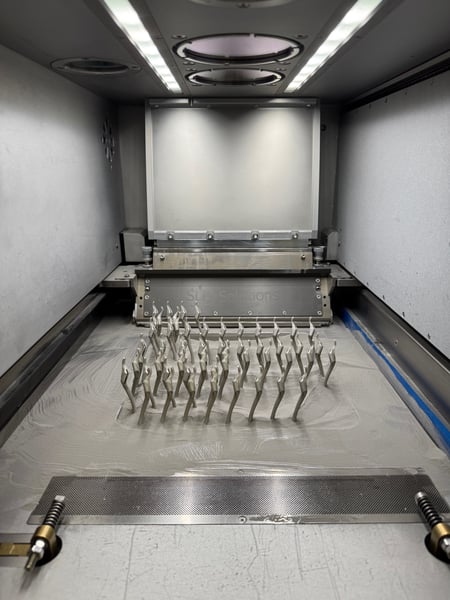
We print metal parts on an SLM 280 2.0 laser powder-bed fusion system, which produces dense, functional components in medical-grade alloys, such as those used for surgical instruments. We provide finished metal AM components from functional prototypes to production.
| SLM 280 2.0 | Metal Laser Powder-Bed Fusion (PBF-LB/M) |
| Optics | Twin 400W IPG fiber laser |
| Build Envelope | 280 × 280 × 365 mm |
| Layer Thickness | 20–75 µm |
| Minimum Feature | 150 µm |
| Materials | 316L & 17-4 stainless steel printed in-house; Additional alloys such as Ti6Al4V ELI (Grade 23); CP titanium (Grade 2); cobalt chrome; and more available on request. |
Typical applications: orthopedic and spinal implants, surgical instruments, and other load-bearing metal components.
Polymer Additive Manufacturing
For polymer additive manufacturing we match the process to your application requirements. We have several processes in-house and will evaluate additional processes and materials as needed.
| Printer | Process | Build Envelope | Typical Resolution | Typical Materials | Best for |
| Formlabs Form 4B | Masked stereolithography (MSLA) | 200 × 125 × 210 mm | 50 µm XY; 25–200 µm Z | BioMed Elastic 50A; 38 Formlabs materials (15 biocompatible) & third-party | Biocompatible functional prototypes & end-use parts |
| Formlabs Fuse 1 | Selective laser sintering (SLS) | 165 × 165 × 300 mm | 200 µm spot; 110 µm layer | Nylon 12 (PA12), Nylon 11 (PA11), Nylon 12 GF, TPU 90 | Durable, support-free nylon parts; jigs & fixtures |
| EnvisionOne cDLM XL | Continuous digital light mfg. (cDLM) | 180 × 101 × 175 mm | 60 µm XY; 50–150 µm Z | Loctite 3843, Loctite Med 413, Loctite IND405, E-Rigidform, medical-grade photopolymer | High-throughput, fine-feature photopolymer parts |
Metal Finishing
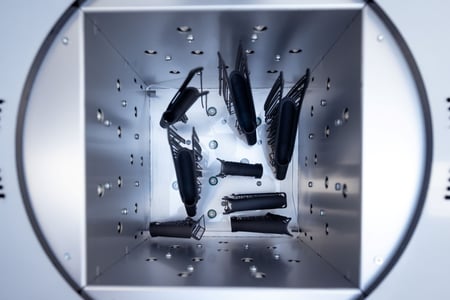
Additively manufactured metal parts almost always require post-processing steps for critical features and surface finish requirements. For small parts requiring smooth surfaces up to a mirror finish without losing critical dimensions and features we bring finishing in-house with DLyte dry electropolishing (DLyte 100Pro) and vibratory finishing. This means that metal AM components can go from print up to a mirror surface under the same roof and the same quality system. DLyte uses a dry electrolyte (no liquid baths) and is non-abrasive, refining the surface while preserving fine additive features and edges.
Three ways we put DLyte Dry Electropolishing to work:
- Additive finishing: post-process SLM 280 metal parts from raw print to a clinically ready surface.
- Contract finishing: send us machined, cast, or printed parts in any DLyte-compatible alloy for a uniform, repeatable finish across the cycle.
- Feasibility & evaluation: run your own geometries on a production-class 100Pro to benchmark surface finish, throughput, and process fit before you invest in the equipment. Deliverables include before/after Ra and dimensional metrology, process documentation, and photos.
| DLyte 100Pro | Dry Electropolishing |
| Surface finish | < 0.1 µm Ra (mirror) |
| Finish envelope | Ø 180 mm × 115 mm |
| Max load / cycle | 8 kg (17.6 lb) |
| Compatible alloys | Stainless, cobalt chrome, titanium, Nitinol, copper-, nickel-, aluminum-based |
| Process | Dry electrolyte — no liquid baths; non-abrasive |
| Quality system | ISO 13485 |
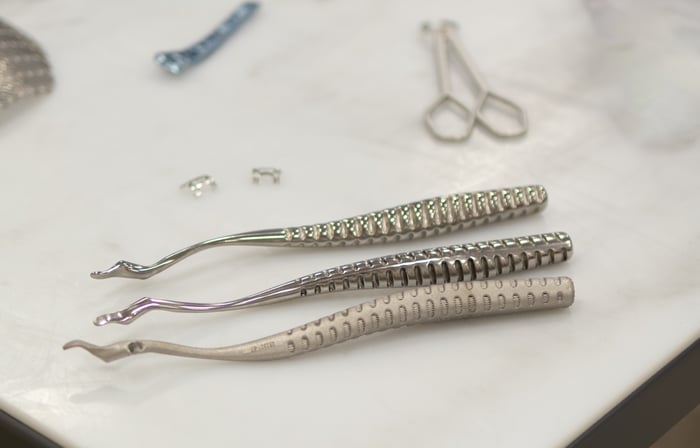
Application Highlight — Metal Additive Manufacturing and Finishing for the DanaMed Pathfinder™ ACL Guide
Kapstone Manufacturing produces this reusable surgical guide in 316L stainless steel on our SLM 280 metal 3D printer and does final surface finishing to obtain mirror finish with DLyte dry electropolishing — a single-source workflow under one ISO 13485 quality system, for a fellow Charlotte, NC medical device company.
Additive Manufacturing as a Validated Production Process
IQ/OQ/PQ in Additive Manufacturing
Additive manufacturing at Kapstone is not only for prototypes. We also run additive for production inside an ISO 13485-certified quality system, meaning we validate and control it as a repeatable production process. This enables the same technology that accelerates early iteration can carry a device into low- and mid-volume commercial production without switching partners. When a program is ready to lock its design, we qualify the additive and finishing processes the same way any production process is qualified: through installation, operational, and performance qualification (IQ/OQ/PQ).
| Stage | What it confirms | How this applies to additive |
| IQ (Installation Qualification) | Equipment is installed and configured to specification. | SLM 280, DLyte 100Pro, and metrology qualified — calibration, software versions, utilities, and environmental controls documented. |
| OQ (Operational Qualification) | The process operates correctly across its parameter ranges. | Establish and challenge the validated parameter window (laser power, scan, layer thickness; DLyte cycle), often via design of experiments, and define worst-case limits. |
| PQ (Performance Qualification) | The process consistently yields conforming product under normal production. | Production-representative lots, first-article inspection, and statistical repeatability (Cpk/Ppk) on critical dimensions and surface finish (Ra). |
Building Additively Manufactured Devices to FDA's Technical Considerations
FDA's guidance Technical Considerations for Additive Manufactured Medical Devices (2017) sets out what to address when a device is made by additive manufacturing — from material controls and the digital-to-physical build workflow through post-processing, process validation, and final testing. We build to that framework under our ISO 13485 quality system. The table below maps FDA's core considerations to how we address them.
| FDA Technical Consideration | How This Can be Addressed |
| Material controls | Controlled receipt, identification, and lot traceability of metal powders and polymer feedstock, including powder-reuse controls. |
| Software workflow & build | Documented digital-to-physical workflow — file preparation, build layout, and machine parameters managed under change control. |
| Post-processing | In-house finishing (DLyte dry electropolishing and vibratory finishing) with controlled, documented steps that preserve critical features. |
| Process validation & acceptance | Equipment and processes qualified through IQ/OQ/PQ with defined acceptance criteria (see the section above). |
| Testing & dimensional measurement | Dimensional metrology and surface-finish (Ra) verification on production-representative parts; mechanical testing coordinated as required. |
| Cleaning & quality data | Removal of manufacturing residues as part of finishing and inspection, documented in the device history record under ISO 13485. |
Reference: U.S. FDA, Technical Considerations for Additive Manufactured Medical Devices — Guidance for Industry and FDA Staff (Dec. 5, 2017). This FDA guidance contains nonbinding recommendations.
Why Kapstone for Prototyping to Production?
-
ISO 13485-certified quality system
-
US-based facility in Charlotte, NC
-
Integrated metal AM (SLM 280) and DLyte finishing on-site
-
More than 10 years in medical additive manufacturing
-
Backed by Kapstone Medical's regulatory and product development experience — one partner from feasibility through manufacturing
Browse our Manufacturing Services:
Product Design & Development for Medical Device Firm
"I liked the 'one-stop shopping' aspect, where only prototype fabrication was outsourced." - Jan 2011 - July 2015 Project Dates
[For years, world-class surgeons loved our 'one-stop' engineering and regulatory approach, but the only friction point was waiting on outsourced prototyping. We listened. That is exactly why we built ISO 13485 Contract Manufacturing through our Kapstone Manufacturing facility in Charlotte—to bring that final piece of the puzzle in-house for our clients.]
"Kapstone Medical designed and built surgical instruments for a medical device firm, including prone lateral spinal access instruments, retractors, and spinal fusion implants. They also handled IP protection."
Retired Neurosurgeon of a Medical Device Company
Additive Manufacturing FAQs
What metals can you 3D print?
Do you finish metal AM parts in-house?
Yes. post-processing of metal AM parts typically includes stress relief, part and support removal, vibratory finishing, and DLyte dry electropolishing, so parts can go from the as-built surface to a mirror finish where necessary (below 0.1 µm Ra).
What's the difference between your MSLA, SLS, and cDLM polymer options?
Do you offer biocompatible 3D-printing materials?
Can I evaluate DLyte on my own parts before investing in equipment?
Yes. Ship or bring your geometries to Charlotte and run real samples on a production-class DLyte 100Pro. We can provide before/after Ra and dimensional data, process documentation, and photos as required.
Can Kapstone Manufacturing take an additively manufactured part from prototype to production and scale up?
How do you validate an additive process for production (IQ/OQ/PQ)?
How do you ensure part-to-part repeatability with additive manufacturing at production volumes?
Where is your Kapstone Manufacturing facility located?
Kapstone Manufacturing is located in Charlotte, NC where we operate under our ISO 13485-certified quality management system.


